
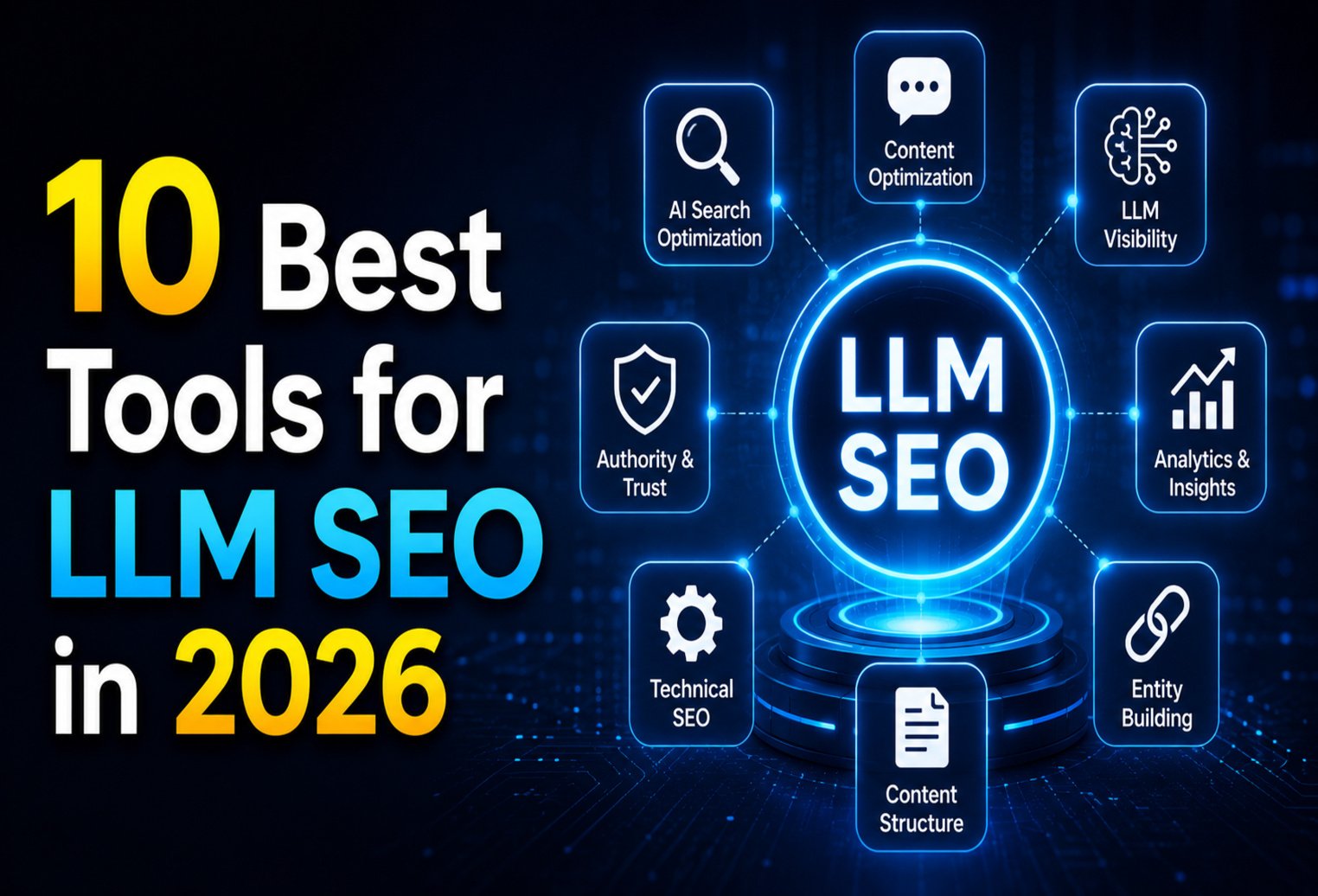
Most SEO teams are still optimizing for search engines like it is 2021. They focus on rankings, backlinks, and keyword density, then wonder why their pages are not being cited in AI answers, surfaced in generative search, or referenced by large language models. The problem is not that SEO stopped working. The problem is that search behavior changed faster than most content systems did. In 2026, ranking on Google is still important, but it is no longer the full game. Your content also needs to be understood, trusted, summarized, and reused by AI systems. That means traditional SEO tools alone are no longer enough. You now need tools that help with semantic structure, entity clarity, answer extraction, topical authority, and machine readability.
This guide covers the best tools for LLM SEO in 2026 and explains what each tool actually does, when it matters, and how to choose the right stack. You will learn which tools improve AI discoverability, which ones help with content intelligence, and how to build a practical LLM SEO workflow that works for both search engines and answer engines.
What Is LLM SEO and Why It Needs Different Tools
LLM SEO is the process of optimizing content so large language models can understand, trust, extract, and cite it in AI-generated responses. Traditional SEO helps content rank in search engines. LLM SEO helps content become usable inside AI systems like ChatGPT, Google AI Overviews, Perplexity, and other generative search interfaces.
This shift matters because AI engines do not behave like traditional crawlers. They do not just scan pages for keywords and links. They evaluate structure, semantic relationships, entity clarity, answer usefulness, and contextual trust. A page that ranks well may still fail to appear in AI-generated answers if its information is difficult to extract or lacks semantic depth.
That is why LLM SEO tools are different from traditional SEO tools. They help you improve content for machine interpretation, not just search indexing. If you want stronger visibility in AI search, better content reuse, and more answer-engine citations, you need a toolset built for that layer.
What Makes a Good LLM SEO Tool in 2026
Not every SEO tool qualifies as useful for LLM SEO. Many are still built around ranking-era signals and offer little value for AI discoverability. A good LLM SEO tool should help improve how machines interpret, organize, and trust your content.
The best LLM SEO tools usually improve one or more of these areas:
- Semantic keyword relationships
- Entity recognition and topical mapping
- AI answer extraction
- Content structure and machine readability
- Knowledge graph relevance
- SERP and AI intent overlap
- Citation likelihood and trust signals
A useful way to evaluate any LLM SEO tool is simple: does it help your content rank, or does it help your content get understood? The strongest tools now do both.
The 10 Best Tools for LLM SEO in 2026
1. Clearscope
Best for semantic optimization and topical completeness
Clearscope remains one of the most useful SEO tools for improving semantic coverage, especially when writing content meant to be understood by both search engines and AI systems. Its biggest strength is not keyword scoring. It is contextual language guidance. It helps writers cover related concepts, supporting entities, and semantic subtopics that improve content completeness.
For LLM SEO, this matters because AI models rely heavily on contextual relevance. A page that covers the main topic but misses adjacent concepts often gets ignored in AI summaries. Clearscope helps close those semantic gaps and makes content more reusable in generative answers.
Use Clearscope when:
- You are writing long-form educational content
- You want stronger semantic coverage
- Your content ranks but does not get cited in AI answers
Its limitation is that it is strongest at content optimization, not full AI visibility analysis.
2. MarketMuse
Best for topical authority and content depth planning
MarketMuse is one of the strongest tools for building topical authority at scale. It helps identify topic gaps, cluster opportunities, and authority weaknesses across an entire site. This is especially useful for LLM SEO because AI systems prefer sources with strong topic depth, not isolated keyword pages.
In practical terms, MarketMuse helps answer a critical LLM SEO question: does your site look like a trusted source on this topic, or just another page targeting a phrase? That distinction matters more in AI search than in traditional ranking systems.
Use MarketMuse when:
- You are building authority in a niche
- You need topic cluster strategy
- You want stronger site-wide semantic trust
It is less useful for quick optimization and better for strategic planning.
3. Surfer SEO
Best for structure optimization and content scoring
Surfer SEO is still highly effective for improving content structure, especially when paired with a strong editorial process. While many teams use it for basic optimization scores, its real value in LLM SEO comes from improving formatting, content hierarchy, and extraction readiness.
AI engines prefer content that is easy to parse. Clear headings, structured answers, logical sequencing, and scannable formatting improve extraction quality. Surfer helps enforce that structure.
Use Surfer SEO when:
- You need cleaner content architecture
- You want better snippet formatting
- Your content needs stronger answer extraction
Surfer works best when used for structure, not blindly for score-chasing.
4. Frase
Best for answer-focused content and AI snippet optimization
Frase is particularly strong for answer engine optimization because it is built around question-based search behavior. It helps identify how users phrase problems, what questions need direct answers, and how content should be structured for snippet extraction.
This makes Frase valuable for LLM SEO because AI engines often prioritize pages that answer clearly before they rank deeply. Frase helps content become easier to summarize, quote, and reuse in generated answers.
Use Frase when:
- You are targeting AI Overviews
- You want more featured snippet wins
- You need stronger FAQ and question mapping
Its strongest use case is answer-first content design.
5. InLinks
Best for entity SEO and topical entity mapping
InLinks is one of the most important LLM SEO tools because it focuses directly on entities, internal topical relevance, and semantic relationships. This is one of the clearest overlaps between traditional SEO and LLM SEO.
Large language models rely heavily on entity understanding. If your content mentions concepts without clear relationships, AI systems are less confident in how to interpret it. InLinks improves entity clarity and helps strengthen machine-level topical understanding.
Use InLinks when:
- You want stronger entity SEO
- You need better internal topical linking
- Your content lacks semantic relationships
For LLM SEO, InLinks is often one of the most underrated tools.
6. AlsoAsked
Best for search intent expansion and query relationships
AlsoAsked helps uncover how users think, not just what they search. It maps query relationships, follow-up questions, and layered search intent. This is highly useful for LLM SEO because AI engines prioritize content that resolves complete intent paths, not just isolated queries.
This tool is especially useful for uncovering hidden intent layers like:
- beginner confusion
- comparison uncertainty
- decision-stage hesitation
Those layers often determine whether your content gets cited in AI-generated responses.
Use AlsoAsked when:
- You need deeper intent mapping
- You want better question clusters
- Your content misses real user context
7. Semrush
Best for hybrid SEO plus AI visibility research
Semrush remains one of the most complete SEO tools available, but its value for LLM SEO is strongest when used as a research and visibility platform. It helps connect traditional SEO performance with broader content opportunity analysis.
Semrush is useful because LLM SEO does not replace SEO. It extends it. You still need keyword opportunity, SERP analysis, content gaps, and competitive benchmarks. Semrush provides the broader search ecosystem view that pure LLM tools often miss.
Use Semrush when:
- You need full-funnel search visibility
- You want competitive content intelligence
- You are combining SEO with LLM SEO
It is not an LLM-native tool, but it remains essential.
8. Ahrefs
Best for topic validation and authority benchmarking
Ahrefs is still one of the strongest tools for validating whether a topic deserves investment and whether your site has the authority to compete. For LLM SEO, that matters because AI systems are more likely to trust pages from sites with clear topical consistency and authority signals.
Ahrefs is especially useful in validating:
- topic demand
- authority gaps
- content decay
- citation-worthy opportunities
It is best used before content creation, not just after publishing.
Use Ahrefs when:
- You need authority validation
- You want stronger topic prioritization
- You need strategic topic filtering
9. Perplexity
Best for testing AI citation visibility
Perplexity is one of the most practical tools for LLM SEO because it lets you observe how AI engines retrieve, summarize, and cite information in real time. It acts like a testing environment for AI search visibility.
This is where strategy becomes practical. You can test whether your content is:
- cited
- summarized accurately
- ignored
- replaced by competitors
That feedback loop is extremely valuable because it shows what AI systems actually do, not what SEO tools predict.
Use Perplexity when:
- You want real AI citation testing
- You need answer-engine validation
- You want to study AI retrieval behavior
10. Google Search Console
Best for grounding LLM SEO in real search behavior
Google Search Console is still one of the most important SEO tools because it shows how users actually find and interact with your content. For LLM SEO, it acts as the grounding layer between search demand and AI discoverability.
Search Console helps identify:
- query-to-page mismatches
- low CTR high-impression opportunities
- intent drift
- content underperformance
These signals help improve both traditional rankings and AI readiness. It is not flashy, but it is still foundational.
Use it constantly, not occasionally.
How to Choose the Best Tools for LLM SEO
The best tool depends less on popularity and more on where your current content is failing.
Choose based on your bottleneck:
- Poor structure: Surfer SEO
- Weak semantic depth: Clearscope
- Low topical authority: MarketMuse
- Weak entity relevance: InLinks
- Poor answer visibility: Frase
- Weak intent mapping: AlsoAsked
- Poor AI citations: Perplexity
- Weak strategy validation: Ahrefs
- Weak competitive research: Semrush
This is the most practical way to choose. Do not buy more tools. Fix the layer that is broken.
Decision Checklist Before Buying Any LLM SEO Tool
Before adding a tool, ask:
- Does this improve rankings or machine understanding?
- Does it solve a content problem or just add data?
- Will this improve AI extraction, trust, or citation likelihood?
- Does it overlap with tools I already use?
- Can my team actually operationalize it?
The best tools are not the ones with the most features. They are the ones your workflow can actually use well.
Conclusion
The best tools for LLM SEO are not just SEO tools with new branding. They solve a different problem. They help content become easier for AI systems to interpret, trust, and reuse. That is the real shift. In 2026, strong content needs to do more than rank. It needs to be understood. The teams that win in AI search will not be the ones with the most tools. They will be the ones using the right tools to improve semantic clarity, entity trust, and answer usefulness.
If you want better visibility in modern search, start by improving how machines understand your content, then build outward. For brands focused on long-term organic growth, this is also where smarter content systems begin. To learn more about SEO strategy and scalable organic systems, visit EasySailor.
Also Read Trending Blog : https://easysailor.in/trending-ipl-broadcast-ai-video-editing-guide-with-prompt/