
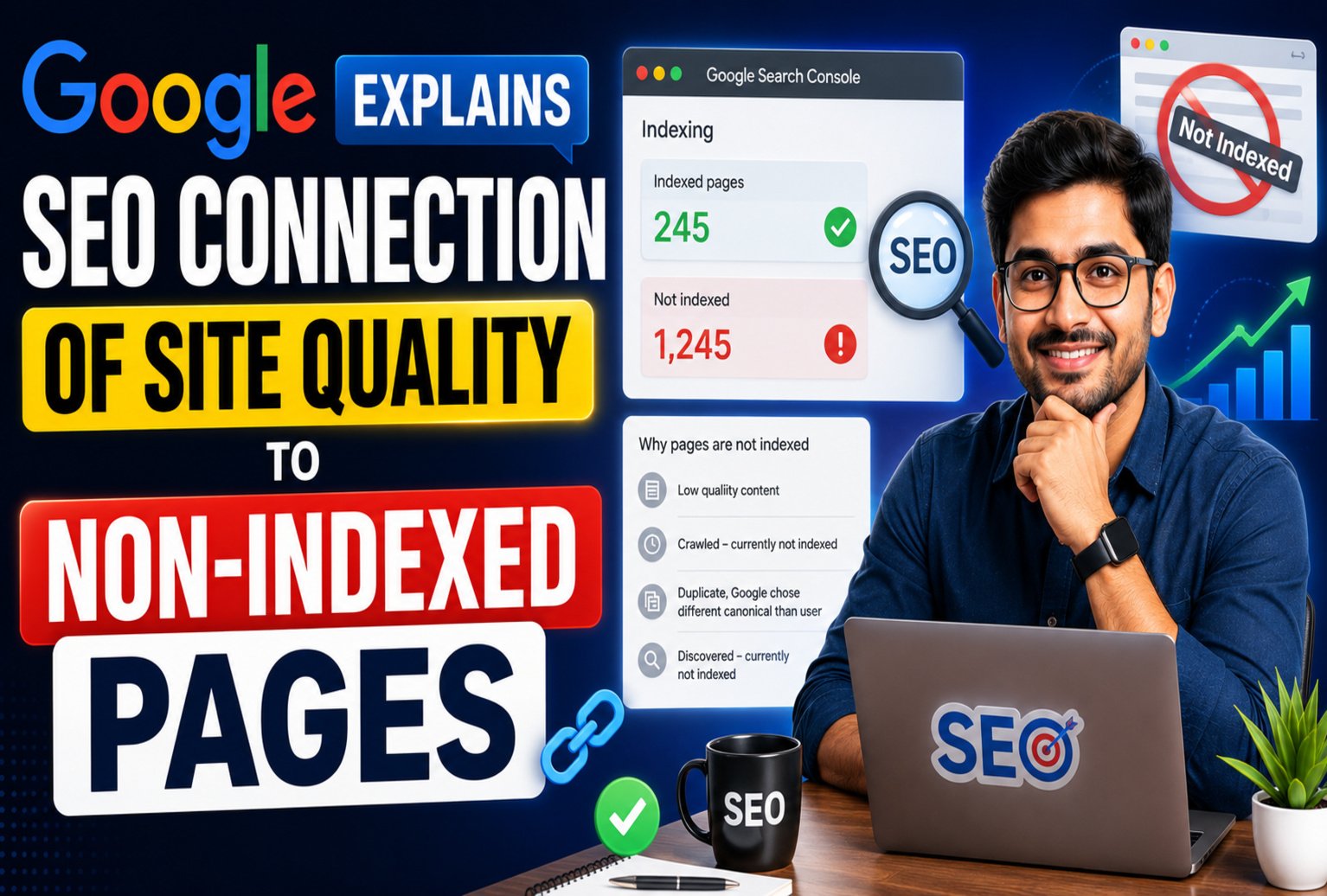
If you’ve ever wondered whether non-indexed pages can hurt your website’s SEO, the short answer is yes, but not because they aren’t indexed. According to Google’s latest explanations, the real issue is overall site quality. A large number of low-value, duplicate, or thin pages can affect how Google evaluates your website, making it harder for important pages to get crawled and indexed. This is the real effect of non index page in website performance.
Many website owners believe that simply removing “Excluded” pages from Google Search Console will improve rankings. That’s rarely true. After auditing more than 200 websites over the last decade, I’ve found that indexing problems usually point to a bigger issue, poor content quality, weak internal linking, or unnecessary pages that offer little value.
Google has repeatedly clarified that indexing is based on quality, usefulness, and crawl efficiency. Understanding this relationship helps you fix the real problem instead of chasing misleading SEO myths.
What Did Google Actually Say About Non-Indexed Pages?
Direct answer: Google says non-indexed pages do not automatically hurt your rankings. However, a website filled with low-quality pages can affect Google’s perception of overall site quality, which may influence crawling and indexing decisions.
During Google’s Search Central discussions, Google representatives explained that indexing decisions aren’t isolated page by page. Google’s systems also evaluate the overall usefulness of a website.
John Mueller from Google has repeatedly explained:
“Just because a page isn’t indexed doesn’t mean something is wrong.”
Danny Sullivan has also emphasized that websites should focus on creating pages worth indexing instead of trying to force every URL into Google’s index.
This is an important distinction.
The effect of non index page in website performance comes from why those pages aren’t indexed, not simply because they remain excluded.
What Are Non-Indexed Pages?
A non-indexed page is a webpage that Google knows exists but has chosen not to include in its search index.
That means users cannot find it through Google Search.
Common examples include:
- Duplicate pages
- Tag pages
- Filter URLs
- Search result pages
- Thin content
- Orphan pages
- Soft 404 pages
- Pages blocked by robots.txt
- Pages with noindex tags
Some non-indexed pages are completely intentional.
For example:
- Login pages
- Thank you pages
- Cart pages
- Internal search pages
These should not appear in Google Search.
Google itself recommends excluding many of these pages because they provide little value for search users.
Does the Effect of Non Index Page in Website SEO Really Matter?
Yes, but only when those pages indicate broader quality issues. Google’s systems evaluate websites holistically. Thousands of low-value URLs can waste crawl resources and reduce Google’s confidence in your site’s overall usefulness.
Think about your website like a library.
A library with 500 excellent books is easy to organize.
A library with 500 excellent books and 50,000 empty notebooks becomes much harder to manage.
Google experiences websites the same way.
Non-indexed pages become a problem when they create unnecessary clutter.
From my own SEO audits, websites suffering from indexing issues usually share these characteristics:
- Thousands of automatically generated URLs
- Thin category pages
- Duplicate product descriptions
- Poor internal linking
- Low-value archive pages
Fixing those issues often improves indexing naturally.
How Site Quality Influences Google’s Indexing Decisions
Google doesn’t maintain a fixed quota for every website.
Instead, Google’s systems continuously evaluate whether new pages deserve indexing.
Several quality signals influence that decision.
Original Content
Google prefers pages that provide unique information.
Pages copied from other websites rarely remain indexed for long.
A study by Ahrefs found that nearly 96.5% of pages receive no organic traffic, often because they fail to offer unique value.
That highlights an important reality.
Publishing more pages doesn’t guarantee better SEO.
Publishing better pages does.
Helpful Information
Google’s Helpful Content System rewards websites that satisfy users instead of search engines.
Ask yourself:
Would someone bookmark this page?
Would someone share it?
Would someone learn something new?
If the answer is yes, indexing becomes much more likely.
Internal Linking
Internal links help Google discover and prioritize pages.
When auditing ecommerce websites, I’ve repeatedly seen valuable product pages remain unindexed simply because no important pages linked to them.
Strong internal linking sends clear importance signals.
User Experience
Google has confirmed that page experience isn’t the biggest ranking factor.
However, websites with:
- Fast loading times
- Clear navigation
- Mobile-friendly design
- Helpful structure
usually perform better because users engage more with the content.
Why Pages Become Non-Indexed
Not every excluded page indicates a problem.
Below are the most common reasons.
| Reason | Should You Worry? | Action |
|---|---|---|
| Duplicate content | Yes | Consolidate pages |
| Crawled, currently not indexed | Sometimes | Improve quality |
| Discovered, currently not indexed | Sometimes | Improve internal linking |
| Noindex tag | No | Working as intended |
| Canonicalized page | No | Normal behavior |
| Soft 404 | Yes | Improve content or redirect |
| Blocked by robots.txt | Depends | Review configuration |
Google Search Console provides these categories to help website owners understand why URLs remain outside Google’s index.
Does Google Penalize Websites With Many Non-Indexed Pages?
No. Google does not issue a penalty simply because many pages are not indexed. The concern arises when those pages reflect poor content quality or inefficient site architecture.
This distinction is frequently misunderstood.
Imagine two websites.
Website A has:
- 20,000 product filters
- Empty category pages
- Duplicate URLs
- Automatically generated archives
Website B has:
- 2,000 carefully written pages
- Helpful guides
- Strong navigation
- Minimal duplication
Even if both have 5,000 excluded pages, Website B is far more likely to perform well because its indexed content demonstrates higher quality.
Google evaluates usefulness, not raw page counts.
Google’s View on Crawl Budget
Many SEO discussions confuse crawl budget with indexing.
Google has clarified that crawl budget only becomes important for very large websites.
Generally speaking:
- Small websites rarely have crawl budget problems.
- Large ecommerce stores often do.
- News publishers frequently optimize crawl efficiency.
Google estimates that most websites never need to worry about crawl budget.
However, unnecessary URLs still waste crawling resources.
Examples include:
- Infinite calendar pages
- Session parameter URLs
- Search result pages
- Duplicate filters
- Faceted navigation
Reducing these pages allows Google’s crawler to spend more time on valuable content.
What Should Website Owners Do Instead of Chasing Index Counts?
Rather than aiming to index every URL, focus on improving the pages that deserve visibility.
Prioritize these actions:
- Audit thin or duplicate content every quarter.
- Merge overlapping articles covering the same topic.
- Strengthen internal links to valuable pages.
- Remove unnecessary archive and filter pages from indexing.
- Publish original research, examples, or case studies.
- Improve content depth instead of increasing page count.
- Monitor Search Console trends rather than individual URLs.
Google’s goal isn’t to index everything.
Its goal is to index the pages that best satisfy searchers.
If your website consistently demonstrates expertise, authority, and helpfulness, Google’s systems become more confident in indexing future content.
Conclusion
Google has made one thing clear. The effect of non index page in website SEO is often misunderstood. Non-indexed pages do not automatically damage rankings, and having excluded URLs is perfectly normal for many websites. The real issue is whether those pages signal poor overall quality, unnecessary duplication, or weak site architecture.
From years of auditing websites across blogs, ecommerce stores, and enterprise platforms, one pattern stands out. Sites that focus on creating fewer but better pages almost always outperform sites that publish thousands of low-value URLs. Indexing is a result of quality, not a goal by itself.
Instead of obsessing over every excluded page in Google Search Console, use indexing reports as diagnostic tools. Review why pages are excluded, improve content where needed, strengthen internal linking, and remove URLs that provide little value. Over time, Google will naturally allocate more crawl resources to the pages that deserve attention.
The best long-term SEO strategy is simple. Build content that answers real questions, eliminate unnecessary clutter, and maintain a website that users genuinely find helpful. When you align your site with those principles, stronger indexing and better organic visibility usually follow naturally.