
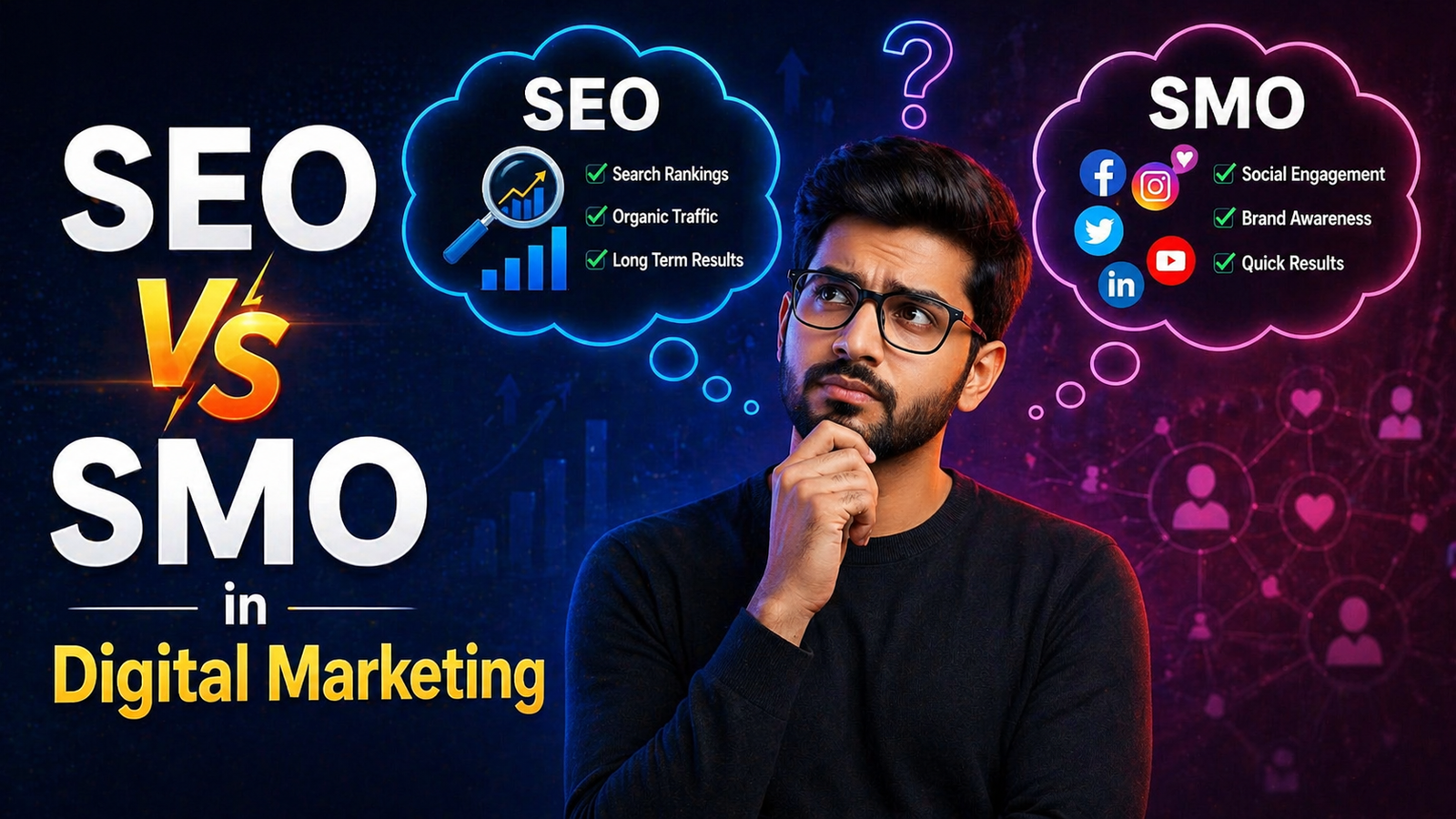
Most businesses do not struggle because they ignore digital marketing. They struggle because they invest in the wrong visibility channel at the wrong stage. Some spend months chasing Google rankings without building brand attention. Others post daily on social media, get likes, and still wonder why traffic and leads stay inconsistent. This is where the confusion between SEO and SMO becomes expensive. The real question is not whether one is better than the other. The real question is what role each plays in growth, visibility, and trust. SEO helps people find you when they are already searching. SMO helps people notice you before they search. One captures intent. The other creates attention.
This guide breaks down the full comparison of seo VS smo in a practical way. You will learn how Search Engine Optimization vs Social Media Optimization actually work, where each performs best, how they influence traffic and conversions, and which one deserves more focus depending on your business stage. If you are comparing SMO vs SEO in Digital Marketing to make smarter marketing decisions, this guide will give you a clear answer.
What Is SEO and Why It Matters
SEO, or Search Engine Optimization, is the process of improving your website so it ranks higher in search engines like Google for relevant searches. The goal is simple: when people search for something related to your business, your website should appear where they can find and trust it. SEO is not just about ranking pages. It is about becoming visible at the exact moment someone is looking for information, products, or services. What makes SEO powerful is intent. Search users are not randomly browsing. They are actively looking for something. That means SEO traffic usually brings better quality visitors because demand already exists. Someone searching for “best CRM for small business” is much closer to action than someone casually scrolling Instagram.
SEO matters because it compounds over time. A strong page can rank for months or years, continue bringing traffic, and improve authority without repeated ad spend. That long-term return is why businesses that invest in SEO build more stable and predictable growth.
What SEO Actually Includes
SEO in 2026 is broader than keywords and backlinks. It works across several layers, and each one affects performance differently.
- On-page SEO focuses on content quality, headings, keyword targeting, internal links, and user clarity
- Technical SEO improves crawlability, speed, mobile usability, and site structure
- Content SEO builds topical authority through useful, well-structured pages
- Off-page SEO builds trust through mentions, links, citations, and authority signals
- Local SEO improves visibility for map-based and local intent searches
The reason SEO feels complex is because it is a system, not a task. Good SEO works when search engines can crawl your content, understand it, trust it, and match it to the right search intent.
What SEO Is Best For
SEO performs best when users already have a need and are actively looking for a solution. It is ideal for businesses that want to capture high-intent traffic and build sustainable growth.
SEO is strongest for:
- Long-term organic traffic
- High-intent lead generation
- Educational content and blog growth
- Service-based businesses
- Local business discovery
- Trust and authority building
SEO is slower than social media, but its strength is stability. Once visibility is earned, it becomes much easier to sustain.
What Is SMO and Why It Matters
SMO, or Social Media Optimization, is the process of improving your brand presence across social platforms to increase visibility, engagement, and discoverability. It is not just posting content. It is about optimizing how your content gets seen, shared, remembered, and acted on across platforms like Instagram, LinkedIn, YouTube, Facebook, and X.
SMO matters because people do not only search on Google anymore. They discover brands on social platforms, evaluate trust through content, and often form opinions before visiting a website. In many industries, social media creates the first impression long before search happens.
This makes SMO especially valuable at the awareness stage. It helps brands stay visible in crowded feeds, create familiarity, and build audience trust through repeated exposure. SEO captures demand.
What SMO Actually Includes
SMO is not just social posting. Strong SMO is a mix of visibility, engagement, positioning, and distribution.
It usually includes:
- Optimizing social profiles with clear positioning and keywords
- Publishing content designed for reach, saves, and shares
- Using platform-native formats like reels, shorts, carousels, and threads
- Improving discoverability with captions, hashtags, and searchable descriptions
- Building engagement through replies, comments, and conversations
- Driving traffic through strategic content funnels
The core idea behind SMO is simple. If people discover your brand socially, your content should make them remember you, trust you, and eventually search for you.
What SMO Is Best For
SMO performs best when the goal is awareness, engagement, and faster attention. It helps brands get seen before users are ready to search.
SMO is strongest for:
- Brand awareness
- Audience building
- Community engagement
- Faster content reach
- Personal branding
- Social proof and trust signals
SMO is faster than SEO, but less stable. Attention can spike quickly, but it fades just as fast when posting stops.
SEO vs SMO: The Core Difference
The biggest difference in search engine Optimization vs Social media optimization is not platform. It is intent.
SEO is built around demand capture. SMO is built around attention creation.
That single difference changes everything about how they work, what they influence, and what results they produce.
| Factor | SEO | SMO |
|---|---|---|
| Primary Goal | Capture search demand | Create attention and engagement |
| User Intent | High intent | Low to medium intent |
| Speed | Slow to build | Fast to launch |
| Traffic Quality | High | Mixed |
| Longevity | Long-term | Short-term |
| Trust Signal | Search credibility | Social proof |
| Conversion Potential | Higher | Indirect |
| Best Use | Demand capture | Demand generation |
SEO works best when people already know what they need. SMO works best when they do not know you yet. That is why comparing them like direct competitors often leads to bad strategy. They serve different stages of the same journey.
SEO vs SMO in Digital Marketing: Which One Should You Prioritize?
The right answer depends on what your business needs now, not what sounds better in theory.
If you need long-term traffic, stable lead generation, and better conversion quality, SEO deserves priority.
If you need visibility fast, stronger brand awareness, and audience growth, SMO deserves priority.
The smartest strategy is not choosing one forever. It is prioritizing one based on business stage while building both intentionally.
Prioritize SEO If
- You want consistent organic traffic
- You sell through search intent
- You need long-term lead generation
- Your audience searches before buying
- You want traffic that compounds over time
SEO is usually the stronger long-term asset because it keeps producing even when publishing slows down.
Prioritize SMO If
- You need attention quickly
- Your brand is still unknown
- You rely on content discovery
- You sell visually or socially
- You need audience trust before conversion
SMO is often the better early-stage growth lever because it helps new brands get noticed faster.
How SEO and SMO Work Better Together
The best-performing brands no longer treat SEO and SMO as separate channels. They use them as connected systems.
Social media creates attention, conversations, and brand recall. SEO captures that interest when users move into research mode. Social content can also surface questions, objections, and language patterns that improve SEO content quality.
This creates a stronger loop:
- Social content builds awareness
- Users search your brand
- SEO content captures intent
- Social proof reinforces trust
- Conversions improve
That is how modern visibility works in 2026.
Conclusion
SEO and SMO are not competing strategies. They solve different parts of the visibility problem. SEO helps people find you when intent already exists. SMO helps people notice you before intent forms. One captures demand. The other creates it. If your goal is long-term traffic, stronger trust, and better lead quality, SEO should be your foundation. If your goal is faster attention, awareness, and audience growth, SMO should support the top of your funnel.
FAQs
Is SEO better than SMO?
SEO is better for long-term traffic, higher-intent leads, and stable growth. SMO is better for faster attention, engagement, and brand visibility. One is not universally better. They solve different growth problems.
Can SMO help SEO?
Yes, indirectly. SMO can increase brand awareness, drive traffic, improve branded searches, and create trust signals that support SEO performance. Social content also helps identify audience questions that improve SEO content strategy.
Which gives faster results, SEO or SMO?
SMO usually gives faster visibility because content can spread quickly on social platforms. SEO takes longer because rankings require indexing, trust, and authority. The trade-off is that SEO usually lasts longer once it works.
Is SEO still worth it in 2026?
Yes. SEO is still one of the strongest long-term traffic channels because it captures high-intent users. What changed is that SEO now works best when supported by broader visibility signals, including social, reviews, and third-party trust.
Should small businesses invest in SEO or SMO first?
Small businesses should usually start with SMO for faster visibility and SEO for long-term stability. If the business depends on search demand, SEO should come first. If the business needs awareness first, SMO should lead.