
Choosing a hosting provider looks simple until your website slows down, your renewal invoice surprises you, or support takes hours when your site is down. That is when hosting stops being a technical decision and becomes a business decision. In this detailed Hostinger vs Namecheap comparison, we will go beyond pricing tables and feature lists. You will understand performance differences, real world usability, renewal traps, scalability limits, and which provider fits specific use cases in 2026.
If you are comparing hostinger vs namecheap for a blog, ecommerce store, portfolio, or agency project, this guide will help you make a decision based on context, not marketing.
What Actually Matters in a Hosting Comparison
Most comparisons focus on storage, bandwidth, and introductory pricing. Those metrics rarely tell the full story.
From real implementation experience across WordPress, SaaS landing pages, and ecommerce setups, five factors determine whether a host works long term:
- Performance consistency under traffic
- Control panel usability
- Renewal pricing transparency
- Support quality during critical issues
- Upgrade path as your site grows
We will evaluate both providers through this lens.
Company Positioning in 2026
Before diving into technical aspects, it helps to understand positioning.
Hostinger positions itself as a performance driven, beginner friendly hosting platform with aggressive pricing and a custom control panel called hPanel.
Namecheap began as a domain registrar and expanded into hosting. It remains popular among domain heavy users and developers who prefer a more traditional setup.
That positioning affects product philosophy, UI design, and customer experience.
Starting Price and Performance Snapshot
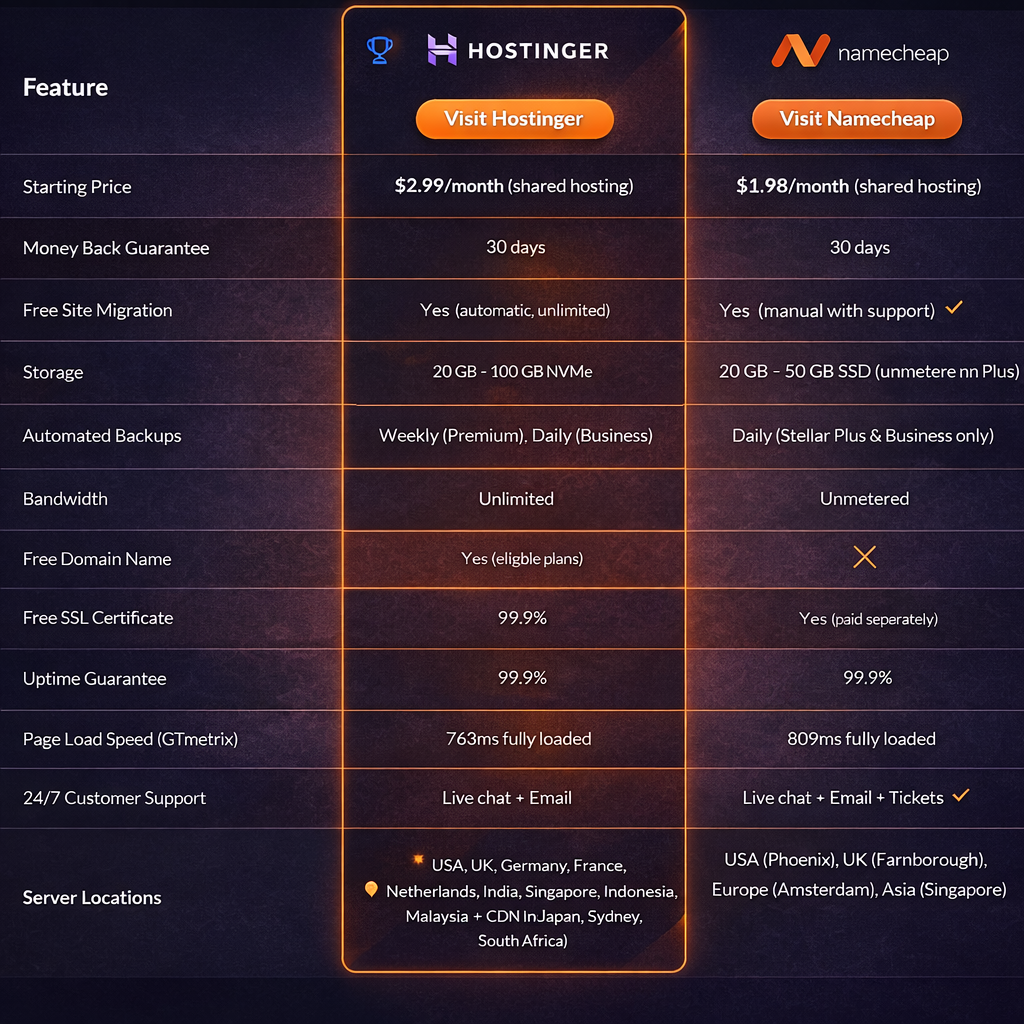
Starting price attracts attention, but performance determines sustainability. This section evaluates the relationship between introductory pricing, storage technology, uptime guarantees, and real world page load speeds. Rather than isolating cost or speed, we analyze how both interact over time. Even small differences in load performance can compound into measurable SEO and conversion impact. At the same time, renewal pricing transparency affects long term budgeting decisions. A balanced snapshot of cost and speed gives a clearer foundation for making an informed hosting choice in 2026.
Starting Price
Hostinger begins around 2.99 per month.
Namecheap begins around 1.98 per month.
Initial affordability favors Namecheap in shared hosting.
Money Back Guarantee
Both offer 30 day guarantees.
Storage
Hostinger uses NVMe storage.
Namecheap uses SSD.
NVMe offers higher throughput performance.
Uptime Guarantee
Both advertise 99.9 percent uptime.
Always validate uptime through third party monitoring when uptime is mission critical.
Page Load Speed
The comparison shows 763 ms fully loaded for Hostinger versus 809 ms for Namecheap in GTmetrix.
While small, consistent speed differences impact SEO performance over time.
Customer Support Channels
Hostinger offers live chat and email.
Namecheap offers live chat, email, and ticket systems.
Channel variety does not guarantee faster resolution.
Hosting Type Availability Comparison
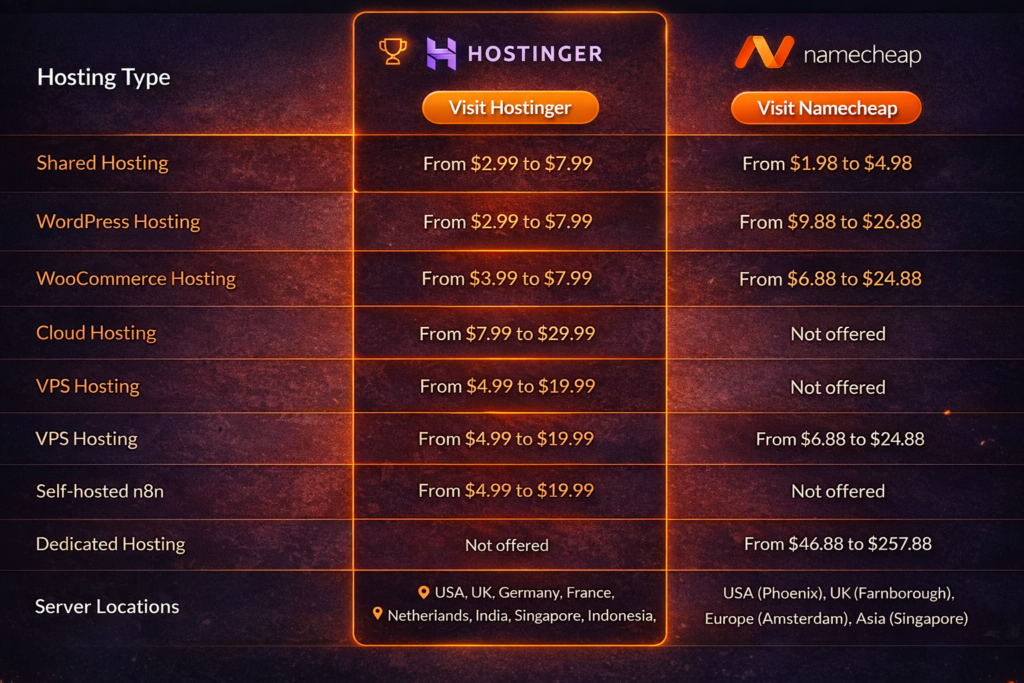
Hosting is not a one size fits all solution. Different business models require different infrastructure layers, from shared hosting for small blogs to VPS or cloud environments for growing applications. This section compares the availability and pricing structure of each hosting category offered by both providers. Instead of focusing only on entry pricing, we examine scalability options and long term flexibility. Understanding hosting type coverage helps you avoid migration stress later. The broader the infrastructure roadmap, the easier it is to scale without disruption.
Shared Hosting
Hostinger ranges from 2.99 to 7.99.
Namecheap ranges from 1.98 to 4.98.
Namecheap appears cheaper at base tier for shared hosting.
WordPress Hosting
Hostinger ranges from 2.99 to 7.99.
Namecheap ranges significantly higher depending on plan.
For WordPress specific hosting, Hostinger positions itself competitively.
WooCommerce Hosting
Hostinger offers lower entry range compared to Namecheap’s higher range.
Ecommerce operators must evaluate not just cost but performance under transactional load.
Cloud Hosting
Hostinger offers cloud hosting options.
Namecheap does not provide direct cloud hosting in the same structure.
Cloud hosting is important for scalable traffic environments.
VPS Hosting
Both offer VPS hosting in varying price ranges, though Hostinger provides competitive entry pricing.
VPS is suitable for developers requiring root access and more resource control.
Dedicated Hosting
Hostinger does not offer traditional dedicated servers.
Namecheap provides dedicated server options.
For enterprise level infrastructure requiring full server control, Namecheap has an advantage.
Server Locations
Hostinger covers USA, UK, Germany, France, Netherlands, India, Singapore, Indonesia, Malaysia and includes CDN presence in Japan, Sydney, and South Africa.
Namecheap lists USA, UK, Europe and Singapore.
Broader geographic coverage improves latency targeting in emerging markets.
Feature Breakdown Comparison
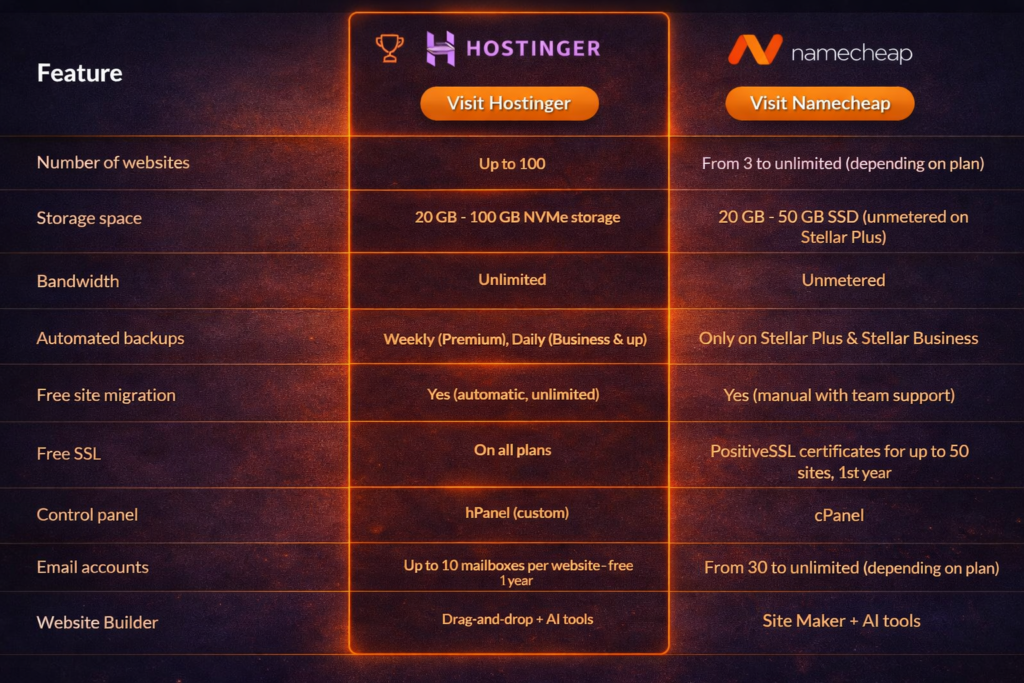
Beyond high level positioning, granular feature differences reveal how each provider structures value inside its plans. Storage type, backup frequency, migration process, SSL inclusion, control panel design, and email limits may look minor individually, but collectively they shape operational efficiency. This section analyzes those features in context, explaining not only what is included but why it impacts cost, performance, and reliability. The goal is to interpret technical specifications through real world usage scenarios. When comparing hostinger vs namecheap hosting, feature bundling often determines whether you need upgrades sooner than expected.
Number of Websites
Hostinger supports up to 100 websites on certain plans. Namecheap ranges from limited sites to unlimited depending on plan.
For agencies managing multiple small sites, site allowance impacts cost efficiency.
Storage Type and Capacity
Hostinger offers 20 GB to 100 GB NVMe storage.
Namecheap offers 20 GB to 50 GB SSD storage, with unmetered storage on select plans.
NVMe storage provides faster I O performance. For database heavy projects, that difference is meaningful.
Bandwidth
Hostinger lists unlimited bandwidth.
Namecheap lists unmetered bandwidth.
Both terms require interpretation. Unlimited typically means no strict cap but subject to fair usage. Unmetered means traffic is not counted but constrained by server resources.
Automated Backups
Hostinger provides weekly backups on premium tiers and daily backups on business plans.
Namecheap restricts daily backups to specific plans.
Backup frequency affects recovery time objective. For ecommerce sites, daily backups are not optional.
Free Site Migration
Hostinger offers automatic unlimited migration.
Namecheap offers manual migration support.
Automation reduces human error and speeds up switching processes.
Free SSL
Hostinger includes SSL on all plans.
Namecheap offers SSL certificates separately depending on plan.
Free SSL inclusion simplifies compliance and security.
Control Panel
Hostinger uses hPanel.
Namecheap uses cPanel.
Choice here depends on user familiarity and workflow preference.
Email Accounts
Hostinger includes up to 10 mailboxes per website free for one year.
Namecheap offers more extensive mailbox allocation depending on plan.
If business email volume is critical, this becomes relevant.
Website Builder
Both offer drag and drop builders with AI tools.
These tools are useful for small businesses but not typically used for complex development.
Customer Support Quality
Support only matters when something breaks.
Hostinger Support
Hostinger relies heavily on live chat and knowledge base resources. Response times are generally good.
Strength:
- Quick chat support
- Strong documentation
Limitation:
- No direct phone support on most plans
Namecheap Support
Namecheap also emphasizes live chat support. Its background as a domain registrar makes it strong in DNS and domain related troubleshooting.
Strength:
- Strong domain management support
- Developer oriented explanations
Limitation:
- Resolution speed may vary depending on complexity
Original Insight 4
Evaluate support not by friendliness but by resolution time during downtime. Downtime cost per hour for a business site should influence your hosting decision more than storage size.
Scalability and Growth Path
Hosting choice must align with future plans.
Hostinger Scalability
Hostinger offers:
- Cloud hosting
- VPS hosting
- Managed WordPress options
Upgrade paths are streamlined within the ecosystem.
Namecheap Scalability
Namecheap provides:
- Shared hosting
- VPS hosting
- Dedicated servers
It may appeal to developers who want traditional VPS control earlier in growth.
Original Insight 5
If you plan to scale into serious ecommerce or SaaS traffic, evaluate how seamless migration between tiers is. Friction during migration often causes unexpected downtime.
Security Features
Both providers include:
- Free SSL certificates
- Basic DDoS protection
- Regular backups depending on plan
Hostinger integrates security features more visibly inside its dashboard.
Namecheap provides strong domain level security features, including domain privacy.
Important note
Security responsibility is shared. No host can compensate for poor plugin management or insecure code.
WordPress Experience
For WordPress focused users, this is critical.
Hostinger WordPress
- Optimized environments
- Automatic installation
- LiteSpeed caching benefits
- Staging options on higher plans
Namecheap WordPress
- Easy installation
- Standard optimization options
- Developer friendly access
If your main focus is blogging or content marketing, Hostinger may offer a smoother setup.
If you prefer manual control and custom configurations, Namecheap may feel more flexible.
Why Hostinger Wins Across Core Decision Factors
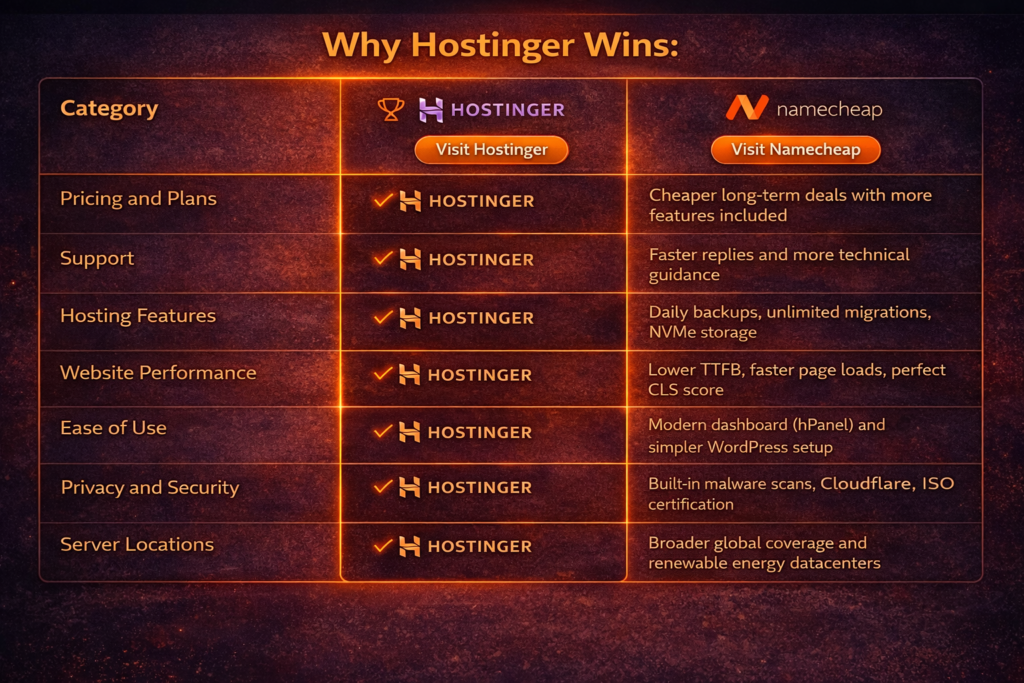
When comparing hosting providers, surface level features rarely tell the full story. The real decision comes down to how pricing, performance, support, usability, security, and global reach work together as a complete ecosystem. This section evaluates those core decision factors through a practical lens rather than marketing claims. Instead of asking which brand sounds bigger, the better question is which platform reduces long term friction. From renewal pricing psychology to dashboard simplicity and real world speed performance, these elements determine everyday experience. Here, we break down why Hostinger appears stronger across several foundational criteria that matter most in 2026.
Pricing and Plans
Hostinger positions itself aggressively for long term value. When comparing multi year plans, it typically includes more features inside lower tiers. That reduces the need to upgrade early.
Namecheap may appear cheaper at entry level in some cases, but feature bundling often requires stepping into higher plans. For users planning long term hosting stability, bundled value matters more than starting price.
Support Quality
The comparison suggests faster replies and more technical guidance from Hostinger. In practice, support effectiveness depends on problem type.
For infrastructure level issues and WordPress troubleshooting, Hostinger’s structured knowledge base combined with live chat can reduce resolution time. For domain specific or DNS related questions, Namecheap remains strong.
What matters is not availability but problem resolution speed during real downtime.
Hosting Features
Daily backups, unlimited migrations, and NVMe storage create a measurable performance and security difference.
NVMe storage improves read write speeds compared to traditional SSD. This impacts database heavy sites such as WooCommerce stores.
Unlimited automatic migrations reduce friction when scaling or switching providers.
Website Performance
Lower Time To First Byte and faster page load speeds influence SEO and conversion rates.
The visual comparison shows stronger GTmetrix performance numbers for Hostinger. Even small differences in load speed compound under traffic spikes.
Performance becomes critical in competitive niches where Core Web Vitals affect rankings.
Ease of Use
Hostinger’s custom hPanel is designed for clarity. Fewer configuration errors happen when UI flows are simplified.
Namecheap’s cPanel appeals to users who prefer traditional hosting control structures.
Ease of use directly impacts how quickly a site can be launched and maintained.
Privacy and Security
Built in malware scans, integrated Cloudflare support, and ISO certifications strengthen Hostinger’s positioning in this comparison.
However, security also depends on user behavior. No hosting environment replaces secure plugin management and regular updates.
Server Locations
Hostinger’s broader global presence allows closer proximity to regional audiences. Geographic proximity reduces latency.
If your audience is distributed across Asia, Europe, and North America, broader server availability becomes strategic rather than cosmetic.
Hidden Considerations Most Reviews Ignore
- Psychological renewal shock affects trust more than actual price difference.
- Beginner friendly panels reduce configuration mistakes.
- Hosting speed advantage matters most in competitive SEO niches.
- Migration complexity increases cost during scaling.
- Domain management convenience saves operational time for agencies.
These practical aspects matter more than advertised bandwidth limits.
Conclusion
The hostinger vs namecheap debate is not about which brand is universally better. It is about alignment with your technical comfort level, growth plans, and pricing expectations. Hostinger excels in beginner friendliness and optimized WordPress performance. Namecheap remains strong in domain management and traditional hosting environments.
Before deciding, calculate long term cost, assess your technical needs, and evaluate how much operational simplicity matters to you. A hosting decision made thoughtfully today prevents performance bottlenecks and migration stress tomorrow.
Frequently Asked Questions: Hostinger vs Namecheap
Is Hostinger better than Namecheap?
The answer depends on what you need. In the Hostinger vs Namecheap comparison, Hostinger generally performs better for hosting performance, speed optimization, and beginner friendly setup. Namecheap is strong in domain registration and basic shared hosting.
If your priority is website speed, uptime stability, and scalable hosting features, Hostinger often has the edge. If your focus is domain management and affordable entry hosting, Namecheap can be sufficient.
The better option depends on whether you are comparing domains or full hosting infrastructure.
What is the disadvantage of Hostinger?
While Hostinger offers strong value, it has some limitations:
- Higher renewal pricing compared to initial promotional rates
- Limited phone support
- Entry plans may have resource restrictions
- Advanced features may require upgrading to higher tiers
For beginners, it is great. But high traffic websites or resource heavy projects may eventually require VPS or cloud hosting plans.
What are the disadvantages of Namecheap?
Namecheap is reliable but has certain drawbacks:
- Hosting performance may not match premium hosting providers
- Shared hosting can struggle under heavy traffic
- Fewer advanced performance tools compared to some competitors
- Support response times can vary during peak periods
Namecheap is excellent for domains and simple websites, but large scale growth projects may require stronger infrastructure.
What is better than Hostinger?
It depends on your use case.
For high traffic business websites, managed WordPress hosting providers may offer better performance and support. For enterprise level needs, premium cloud providers may be stronger.
However, in the Hostinger vs Namecheap discussion for small businesses and bloggers, Hostinger is already a strong value option in its price category.
The key is matching your hosting environment to your website goals.
Can I use a Namecheap domain on Hostinger?
Yes, absolutely.
You can purchase a domain from Namecheap and connect it to Hostinger hosting. You simply need to update the nameservers in your Namecheap domain dashboard to point to Hostinger’s servers.
This setup is very common and works without issues.
Which is cheaper: Hostinger or Namecheap?
Both companies offer competitive entry pricing. Namecheap is often slightly cheaper for domain registration, while Hostinger frequently offers aggressive discounts on hosting plans.
However, long term renewal pricing matters more than the initial discount. Always compare:
- Initial price
- Renewal price
- Included features
- Free SSL availability
- Backup options
Cheap upfront pricing does not always mean cheaper long term cost.
Which is better for beginners: Hostinger or Namecheap?
In the Hostinger vs Namecheap comparison for beginners, Hostinger often wins due to:
- Intuitive control panel
- One click WordPress installation
- Clear performance dashboard
- Beginner friendly tutorials
Namecheap is simple too, but Hostinger’s interface feels more streamlined for new website owners.
Which is better for WordPress: Hostinger or Namecheap?
Hostinger typically performs better for WordPress hosting because:
- It offers optimized WordPress servers
- Built in caching features
- Better loading speed under shared hosting
Namecheap can host WordPress sites, but performance optimization may require manual setup.
If WordPress performance is a top priority, Hostinger often has the advantage.
Does Hostinger provide better speed than Namecheap?
In many performance tests, Hostinger shows faster loading times due to:
- LiteSpeed web server integration
- Built in caching tools
- Optimized server configurations
However, actual speed depends on your theme, plugins, and optimization strategy. Hosting is one factor among many.
Is Namecheap more secure than Hostinger?
Both providers offer:
- Free SSL certificates
- Basic security tools
- DDoS protection
Security differences are usually minimal at the shared hosting level. Website security also depends on how well you maintain your CMS, plugins, and passwords.
Can I migrate my website from Namecheap to Hostinger?
Yes, website migration is possible and often free. Hostinger provides migration support for many hosting plans.
You will need:
- Website files
- Database backup
- Domain access
Migration is straightforward if done properly.
Is Hostinger vs Namecheap comparison still relevant in 2026?
Yes, because both companies continue updating pricing, features, and performance tools. Hosting technology evolves, and performance standards rise each year.
In 2026, the real comparison is not just about price but about:
- Performance stability
- Scalability
- Support quality
- Long term cost
The best choice depends on whether you prioritize affordability, speed, scalability, or domain management.